Can trees explode in cold weather?
No, but on a bitter night a trunk can split open with a bang like a gunshot. What a frost crack is, which trees get one, and the forecast that sets it off.
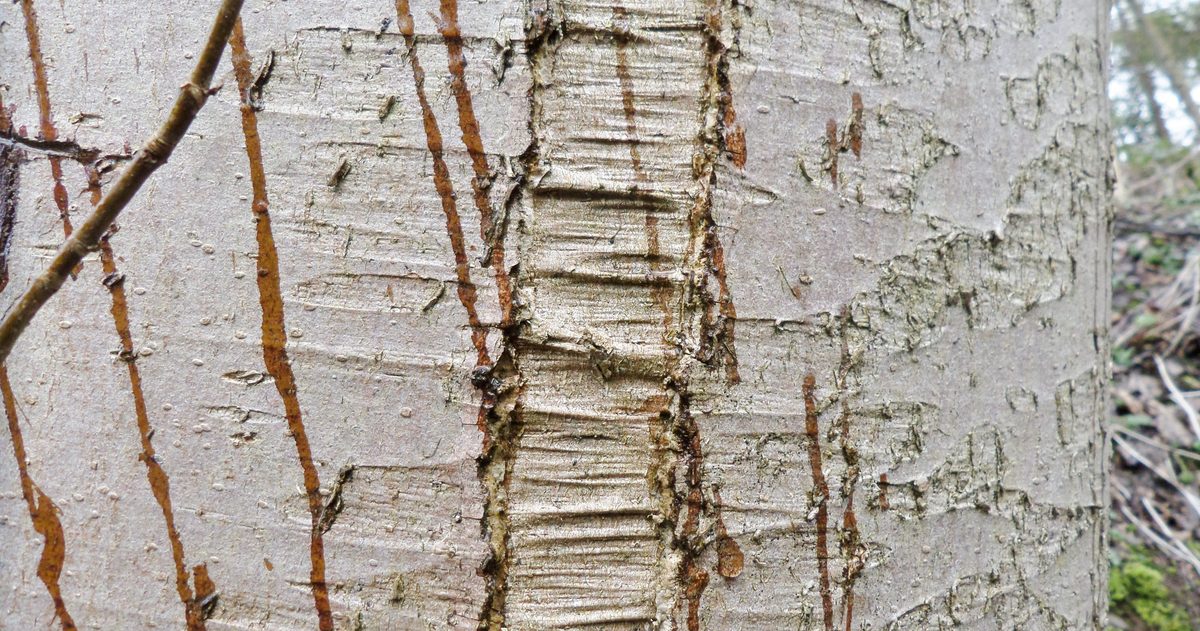
Trees do not explode in cold weather, but their trunks can split open suddenly with a crack that extension specialists compare to a shotgun or rifle shot. The split is called a frost crack: a vertical seam, often several feet long, that opens when a trunk freezes far below 32°F (0°C) and narrows again as it warms. It looks alarming, yet trees are quite capable of living with one, even when it reopens in later winters.
What actually happens when a tree "explodes"?
The popular explanation is that sap freezes, expands and bursts the trunk. Research says that is only a small part of it. In a 1987 paper in the Journal of Arboriculture, Hans Kubler of the University of Wisconsin noted that freezing water expands by 9% in volume, but most wood cells also hold some air, so the ice mostly expands into that space without stretching the cell. He called freeze expansion "only a minor secondary cause".
The main cause, in Kubler's account, is frost shrinkage. Below 32°F, ice forms in the cell cavities and pulls moisture out of the cell walls, and the colder it gets, the more water moves. The walls dry and thin, so the wood shrinks, and it shrinks more along the growth rings than across them. That builds tension around the trunk until it breaks. In his model, the outer growth ring fails when stretched only about 1%. The crack typically runs several feet up the stem and occasionally reaches the crown.
Many extension fact sheets give an older explanation: bark and wood contract at different rates as they cool, and the bark splits, in Purdue Extension's words "sometimes violently enough to produce a rifle-like noise". Kubler listed that explanation among the misconceptions about frost cracks. Green wood from living trees contracts very little as it cools, he wrote, and a crack caused by the surface contracting would stay near the surface, while most frost cracks reach the center of the stem. Iowa State's 2026 explainer also calls it the conventional wisdom before turning to Kubler. Both accounts agree on the sound: a sudden release of built-up tension, not a blast.
The sources describe two settings. One is a deep winter freeze, what Iowa State calls an extreme low temperature event, which can split large trunks. The other is driven by the sun: on a cold, bright day the sun warms the bark and the cambium (the thin living layer just under the bark) on the south or southwest side of a thin-barked tree, and both cool quickly at sunset. Extension services call the bark damage this causes sunscald, or southwest injury when it hits the lower trunk on the southwest side.
Why does "explode" overstate it?
"Exploding trees" headlines ran in January 2026 as winter temperatures dropped across much of the country, and Iowa State, Purdue and Illinois Extension all published explainers between January 22 and 30. Iowa State called frost cracks "a more appropriate term". Illinois Extension said the claim was "a little exaggerated" and nothing like the fire-filled explosions of an action movie. A Purdue Extension educator wrote that in more than 30 years he had never heard a Purdue specialist use the term.
Nothing burns. What you get is a long split, usually low on the trunk, and Illinois Extension notes that it may not be obvious right away. The bang is real, which is why the word stuck.
How cold does it have to be for trees to crack?
There is no single trigger temperature. Kubler wrote that frost cracks happen below freezing and that the colder the stem, the more likely the crack and the wider it opens. Even then, many trees do not crack: in lab trials Kubler describes, 1-foot-thick (30 cm) stem sections were cooled to minus 40°F (minus 40°C), and some cracked while others did not. The forecast signals the sources point to, in the order a winter day brings them:
| Forecast signal | Why it matters | Source |
|---|---|---|
| Bright, sunny winter afternoon | The southwest side of a trunk can be as much as 77°F (43°C) warmer than the north side | NDSU Extension |
| Sun sets or slips behind a cloud | Warmed bark and cambium drop quickly back to air temperature | Purdue and Minnesota Extension |
| Clear sky at night | Net heat loss to space is more pronounced under a clear sky | National Weather Service |
| Overnight plunge from above 32°F (0°C) to about minus 4°F (minus 20°C) | The USDA Forest Service oak study areas in Maine and Connecticut see drops like this, and the authors linked them to cracks reopening | Butin and Shigo, USDA Forest Service |
| Extreme Cold Warning | Criteria are set locally; around Rochester, New York, it means minus 25°F (minus 32°C) or colder | National Weather Service |
The "frost" in frost crack is misleading: an ordinary first frost of fall does not do this. Our Minneapolis page counts 148 nights a year below 32°F from ERA5 data, and an ordinary frost night is not what cracks trees: Iowa State ties frost cracks to extreme low temperature events in winter. Cold of that kind can come when Arctic air spills south, which our guide to the polar vortex and US cold outbreaks explains, and the Canadian version covers the snaps north of the border.
Which trees get frost cracks?
Thin bark is the common thread for the sun-driven kind. Extension lists of trees prone to winter sun injury (sunscald and southwest injury), which Purdue and Illinois tie directly to frost cracking, name:
- Maples (Illinois, Purdue, Minnesota and NDSU all name them)
- Linden, honeylocust, beech and willow (Illinois)
- Fruit trees: apple, crabapple, cherry, pear and plum (Illinois, Minnesota, NDSU)
- Mountain ash and redbud (Minnesota, NDSU, Purdue)
- Young and newly planted trees of any species, because their bark is thinner. Purdue says the risk of southwest injury drops once trunks pass about 4 inches (10 cm) in diameter.
Thick bark does not make a tree immune. In a USDA Forest Service study, Heinz Butin and Alex Shigo dissected 25 frost-cracked oaks in southern Maine and seven in Connecticut and found the cracks associated with earlier wounds, branch stubs or basal sprout stubs. Their conclusion was that frost cracks "are not caused by frost", although frost keeps them going. Kubler calls this the notch effect: a buried flaw is where the tension finds its way out, and it appears to be the main reason one tree splits while its neighbor does not. In California's Sierra Nevada, a Forest Service study of white fir found frost cracks two to three times more common on the colder east slope, with about 85% of them in the lowest 16 feet (4.9 m) of trunk.
Do frost cracks kill trees?
Usually not. Iowa State Extension says trees "are quite capable of living with frost cracks, even if they reopen in subsequent years." What happens next follows a pattern:
- The crack closes as the wood warms back toward 32°F.
- In spring the tree grows callus, new tissue that closes over a wound, along the edges. Illinois Extension puts callus growth at about half an inch (1.3 cm) a year.
- The next hard winter often splits it open again, so the seam can reopen year after year.
- The repeated healing leaves a raised ridge called a frost rib, visible for many years.
How long that takes varies enormously. In the white fir study, 59 permanently healed cracks had taken between 2 and 162 years to close, 37 years on average. The real cost is the open door: Purdue and Illinois Extension both note that the split lets in wood-decaying organisms and insects, and Kubler concluded that frost-cracked trees, on average, do not live as long as others.
There is no cure. Iowa State says there is no known effective way to prevent or treat frost cracking, and Illinois and Minnesota Extension both advise against painting or tarring a trunk wound.
Is a cracked tree dangerous to people or houses?
The evidence on the split itself is reassuring but limited: hazard-tree records cited in the Forest Service white fir study showed no breakages or accidents directly attributed to frost crack in 133 true firs. The risk builds over time: Illinois Extension warns that repeated cracking at the same spot can weaken a tree structurally and make it more likely to break.
University of Kentucky Extension's hazard-tree guide says large cracks that go through the bark into the wood "should raise immediate red flags", and that trees near houses and places where people gather should be checked first. Its advice for a suspect tree is to contact a professional forester or arborist.
Can you prevent frost cracks?
Not reliably, as Iowa State points out, but Illinois Extension lists steps that help minimize the risk, mostly for young, thin-barked trees:
- Wrap the trunk, preferably in white. Illinois and Minnesota recommend white tree wrap or white guards to reflect the sun, put on in fall and taken off in spring. The sources disagree on paper: Minnesota says not to use brown paper tree wrap because it absorbs heat from the sun, while NDSU's instructions use brown Kraft paper or white plastic guards. Minnesota and NDSU suggest at least two winters for new trees and up to five for thin-barked species, and both warn against black guards, which absorb heat.
- Do not wound the trunk. Mower and string-trimmer damage creates exactly the flaws that cracks later follow.
- Water before the ground freezes. Illinois Extension says trees that enter winter under moisture stress are more vulnerable.
Wind chill does not change any of this. The NWS index describes heat loss from skin, and for objects such as pipes and car radiators it says wind only brings them to the air temperature faster, so for a trunk the forecast low is the number to watch. Our city pages put three forecast models side by side for the coming days, the NWS blend, GFS and ECMWF across the US and Environment Canada's GEM, ECMWF and GFS across Canada, and flag the days where they split. A sunny afternoon followed by a clear night far below zero is the setup the extension services describe.